
Last updated on
Oct 31, 2026

NC Table 4019 free printable template
pdfFiller is not affiliated with any government organization

Fill out
Complete the form online in a simple drag-and-drop editor.

eSign
Add your legally binding signature or send the form for signing.

Share
Share the form via a link, letting anyone fill it out from any device.

Export
Download, print, email, or move the form to your cloud storage.
Why pdfFiller is the best tool for your documents and forms


End-to-end document management
From editing and signing to collaboration and tracking, pdfFiller has everything you need to get your documents done quickly and efficiently.
Accessible from anywhere
pdfFiller is fully cloud-based. This means you can edit, sign, and share documents from anywhere using your computer, smartphone, or tablet.
Secure and compliant
pdfFiller lets you securely manage documents following global laws like ESIGN, CCPA, and GDPR. It's also HIPAA and SOC 2 compliant.
What is NC Table 4019
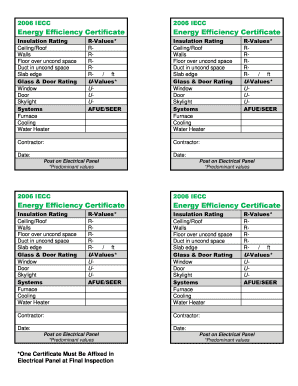
The Energy Efficiency Certificate is a property disclosure form used by builders, permit holders, or registered design professionals to document energy efficiency ratings of a property, including insulation values and test results.
pdfFiller scores top ratings on review platforms




It has helped me out a TON with filling out my packages for the military. Saves me ALOT of time!
Pretty good so far, without any guidance. The webinar will help.
Who needs NC Table 4019?
Explore how professionals across industries use pdfFiller.

NC Table 4019 is needed by:
-
Builders completing new constructions or renovations
-
Permit holders needing to verify energy efficiency
-
Registered design professionals ensuring compliance
-
Real estate agents managing property transactions
-
Homeowners seeking to understand energy performance
-
Inspectors assessing property standards
Comprehensive Guide to NC Table 4019
What is the Energy Efficiency Certificate?
The Energy Efficiency Certificate serves to document the energy efficiency ratings for real estate properties, highlighting various aspects such as insulation values and building air leakage tests. It becomes an essential part of property disclosure, ensuring buyers are informed about the property's energy performance.
Key terms associated with the certificate include insulation values, which refer to a building's thermal resistance, and building air leakage tests, which evaluate the tightness of the construction. Displaying this certificate prominently on the property is crucial as it assures potential buyers of the energy efficiency standards met by the home.
Purpose and Benefits of the Energy Efficiency Certificate
Obtaining the Energy Efficiency Certificate carries multiple advantages for homeowners, builders, and prospective buyers. Firstly, it enhances property value, as a certificate indicating high energy efficiency is attractive in the real estate market. Additionally, energy-efficient homes tend to consume less energy, leading to significant cost savings over time.
Furthermore, many local regulations require this certificate, and completion can lead to potential incentives from authorities promoting energy conservation. By securing this document, homeowners can ensure compliance with laws aimed at reducing energy consumption.
Who Needs the Energy Efficiency Certificate?
Several key stakeholders must obtain or complete the Energy Efficiency Certificate during real estate transactions. Builders play a pivotal role in ensuring that properties are compliant with energy standards. Likewise, permit holders and registered design professionals are tasked with certification responsibilities to ensure accurate energy performance documentation.
In particular scenarios, such as when properties are being sold or leased, this certificate becomes a mandatory requirement. The accuracy in completing the form is vital, as it impacts the overall integrity of the energy disclosure process.
How to Fill Out the Energy Efficiency Certificate Online (Step-by-Step)
Completing the Energy Efficiency Certificate online involves a few key steps. Start by accessing the digital form and filling in essential fields such as Print Name, Signature, and Property Address.
-
Input insulation test results, detailing values that reflect the home’s thermal performance.
-
Document results from building air leakage tests.
-
Carefully review each entry for accuracy before submission to avoid common errors.
Ensure that all necessary fields are filled out completely, as incomplete submissions may delay processing.
Key Features and Sections of the Energy Efficiency Certificate
The Energy Efficiency Certificate comprises several essential components. Among them are fillable fields that require specific information, such as property address and test results for insulation ratings and leakage tests.
Understanding terms like fenestration U-factors, which represent the performance of windows and doors, is crucial. Each section of the certificate contributes to a comprehensive assessment of the property's energy efficiency, playing a vital role in helping stakeholders evaluate energy performance effectively.
Common Errors and How to Avoid Them
While filling out the Energy Efficiency Certificate, users may encounter various common errors. These can include inaccurate insulation values and incomplete fields that may hinder the certification process.
-
Double-check all figures before submission to ensure accuracy.
-
Verify that all required fields are filled in completely.
Use available resources to validate entries and reduce the likelihood of mistakes, ensuring a smoother submission process.
Submission Methods for the Energy Efficiency Certificate
Once the Energy Efficiency Certificate is completed, users have various submission methods available. They can choose between digital submission through the designated platform or physical submission using conventional mail.
Tracking the status of the submission can often be done online, allowing users to receive confirmation of receipt. Users should be aware of any applicable fees and typical processing times to better manage expectations regarding the certification decision.
How pdfFiller Can Simplify the Energy Efficiency Certificate Process
Utilizing pdfFiller to complete the Energy Efficiency Certificate offers several advantages. The platform provides intuitive features for editing and filling out forms, making the overall process seamless for users.
Moreover, pdfFiller prioritizes security with encryption protocols to safeguard sensitive information. Users are encouraged to take advantage of the platform's eSigning capabilities, which facilitate secure sharing of the completed certificate.
Security and Compliance for the Energy Efficiency Certificate
Security remains a top priority when handling the Energy Efficiency Certificate. pdfFiller employs robust measures, including encryption and compliance with standards such as HIPAA and GDPR, to ensure personal data remains protected during the completion process.
To maintain privacy while filling or sharing forms, users should adhere to best practices for data security and consider recommendations for retaining records of completed certificates.
Next Steps After Filling Out the Energy Efficiency Certificate
After submitting the Energy Efficiency Certificate, users should be aware of the necessary follow-up actions. Any errors noted post-submission can often be corrected by submitting an amendment to the certification authority.
It is also advisable to periodically check the application status to ensure the certification process is progressing. Keeping a copy of the completed certificate is crucial for personal records and future reference.
How to fill out the NC Table 4019
-
1.Start by visiting pdfFiller and searching for the Energy Efficiency Certificate form.
-
2.Once located, click on the form link to open it in the editing interface.
-
3.Before filling out the form, collect necessary information including insulation ratings, fenestration U-factors, and air leakage test results from relevant sources.
-
4.Navigate to each fillable field, including 'Print Name', 'Signature', 'Property Address', and 'Date'. Click on the field to start typing your information.
-
5.Fill in the insulation ratings and ensure accurate entry of the air leakage and duct leakage test results.
-
6.Review all the entered details for completeness and accuracy once you've filled in the required fields.
-
7.Use pdfFiller’s preview function to check how the finalized form will appear once printed.
-
8.When satisfied, you can save your progress or download the form as a PDF. Depending on your needs, you may also submit the form electronically through pdfFiller.

Who is eligible to fill out the Energy Efficiency Certificate?
The Energy Efficiency Certificate can be completed by builders, permit holders, or registered design professionals. These individuals must be qualified to provide accurate energy efficiency ratings and test results.
Is there a deadline for submitting the Energy Efficiency Certificate?
While specific deadlines may vary by locality, it is often required to be completed before a property’s sale or rental. Verify local regulations for timely submissions.
What methods are available for submitting the completed form?
The completed Energy Efficiency Certificate can typically be submitted in person to local municipal authorities, or may be submitted electronically if allowed by your region’s regulations.
Are there supporting documents required with the Energy Efficiency Certificate?
In general, you may need to attach supporting documents such as inspection reports or copies of test results to validate the information provided in the Energy Efficiency Certificate.
What are common mistakes to avoid when filling out this form?
Common mistakes include providing incorrect insulation ratings, failing to sign the document, or leaving required fields blank. Ensure all information is accurate and complete.
What are the typical processing times for the Energy Efficiency Certificate?
Processing times can range from a few days to several weeks, depending on local authority timelines. It's best to submit the form as early as possible to avoid delays.
Do I need to notarize the Energy Efficiency Certificate?
Notarization is not typically required for the Energy Efficiency Certificate, but it is important to check local regulations to confirm specific requirements in your area.
Related Forms





Related Catalogs
Get the latest insights from our blog


If you believe that this page should be taken down, please follow our DMCA take down process
here
.
This form may include fields for payment information. Data entered in these fields is not covered by PCI DSS compliance.